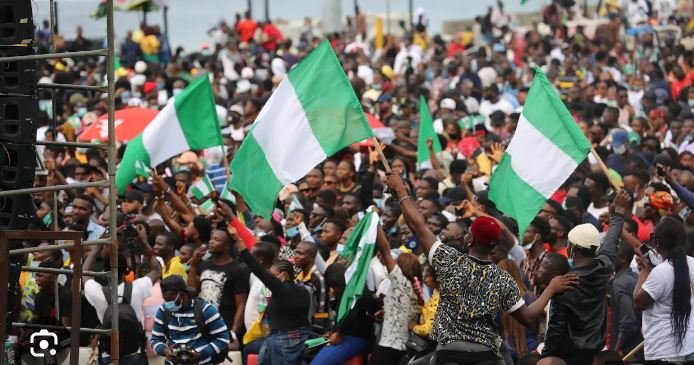

Nigeria on January 15, 2026, marked 60 years since the country’s first military coup of 1966, a watershed moment that ended the First Republic and reshaped the nation’s political history, even as the date was observed nationwide as Armed Forces Remembrance Day to honour fallen military personnel.
The anniversary underscored a striking dual legacy: a day set aside to remember soldiers who paid the supreme price in the two World Wars, the Nigerian Civil War, peacekeeping missions and internal security operations, while also recalling the military intervention that plunged Nigeria into decades of military rule.
In the early hours of January 15, 1966, a group of young army officers led by Major Patrick Chukwuma Kaduna Nzeogwu overthrew the civilian government of Prime Minister Abubakar Tafawa Balewa. President Nnamdi Azikiwe, then ceremonial head of state, was out of the country. Several top political and military leaders were assassinated across parts of Nigeria, throwing the young nation into turmoil barely six years after independence.
Although the coup plotters claimed to be acting against corruption and political instability, the action collapsed democratic governance and triggered a chain of counter-coups, ethnic tensions and events that culminated in the 1967–1970 Nigerian Civil War.
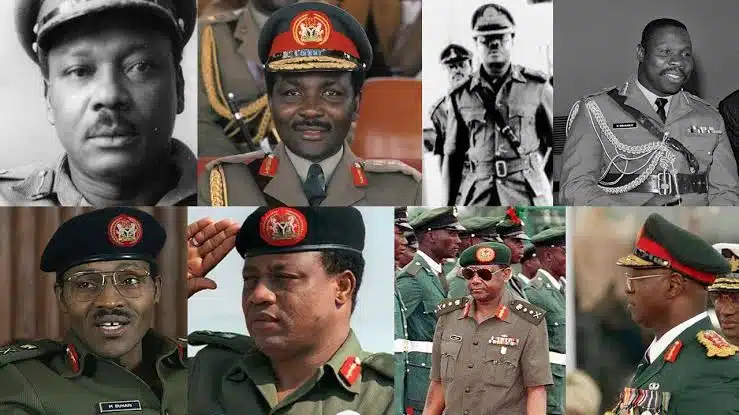
Following the coup, Major General Johnson Aguiyi-Ironsi emerged as Nigeria’s first military head of state, ruling from January 1966 until his assassination in a counter-coup on July 29, 1966. He was killed alongside Western Region military governor, Lt. Col. Adekunle Fajuyi, during an uprising led by northern officers amid growing regional mistrust.
READ ALSO: Dollar Sells for ₦1,500 in Lagos Black Market
Power then shifted to Lt. Col. Yakubu Gowon, who was installed as head of state in August 1966. Gowon later promoted himself to major general and then full general, steering the country through the civil war and ruling until 1975, when he was overthrown in a bloodless coup.
General Murtala Muhammed took power in July 1975 but was assassinated in an abortive coup on February 13, 1976. His deputy, Lt. Gen. Olusegun Obasanjo, succeeded him, continued his reform agenda and eventually handed over power to an elected civilian government in 1979, ending 13 consecutive years of military rule.
Civilian governance returned briefly before another coup in December 1983 brought Major General Muhammadu Buhari to power, ending the Second Republic led by President Shehu Shagari. Buhari’s regime was itself overthrown in 1985 by General Ibrahim Babangida, whose eight-year rule was marked by political engineering, economic reforms and the annulment of the June 12, 1993, presidential election.
General Sani Abacha seized power later in 1993, ushering in one of Nigeria’s most repressive military eras. His death in 1998 paved the way for General Abdulsalami Abubakar, who supervised a transition programme that culminated in the return to civilian rule on May 29, 1999.
Sixty years on, January 15 remains a powerful reminder of Nigeria’s complex civil-military history a date that honours sacrifice while reflecting on the profound consequences of military intervention in politics.