
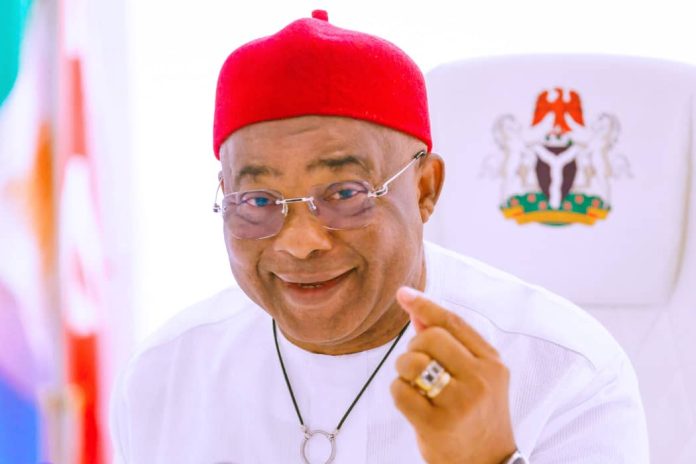
From January to November 2025, Imo State witnessed one of the most intense periods of government activity since the return of democratic governance, as Governor Hope Uzodinma rolled out an ambitious suite of projects targeting roads, digital transformation, youth empowerment, power supply, healthcare, and institutional reforms.
Though the administration has always been vocal about its vision of transforming Imo into a competitive economic center in the Southeast, 2025 became the year in which that blueprint took clearer, measurable shape.
Across the state’s 27 local government areas, new asphalt roads appeared, bulldozers roared, digital hubs sprang up, youth cohorts graduated from tech programmes, and preparations for a 24-hour-power future intensified. These developments were neither incidental nor isolated they reflected a deliberate, multilayered strategy embedded in the state’s long-term development plan and powered by a 2025 budget that significantly expanded capital expenditure.
This report follows Governor Uzodinma’s activities from January to November, highlighting the big moves, policy pivots, achievements, and persistent pressures shaping Imo’s trajectory in 2025.
A January of Promises and Policy Direction
Governor Hope Uzodinma began 2025 with a New Year broadcast that centered on stability, accelerated development, and a renewed pact with the people of Imo State. He positioned 2025 as a year of consolidation one that would focus simultaneously on physical infrastructure, digital inclusion, and broader governance improvements.
The administration’s policy direction became clearer almost immediately with the signing of the 2025 Appropriation Bill, a budget structured around heavy capital spending. Road construction, digital economy investments, healthcare improvements, and a power supply overhaul featured prominently. Uzodinma’s team emphasized that this was the most development-oriented budget since the governor assumed office, signaling an aggressive push to complete legacy projects ahead of 2026.
In January, the government also intensified planning for its digital skills programme known as SkillUp Imo, a youth-targeted initiative designed to prepare thousands for global opportunities in technology and business process outsourcing. Meetings with partners and private-sector players set the tone for what would become one of the administration’s most visible social empowerment efforts.
Road Infrastructure Dominates the First Quarter
Between February and March, Imo State effectively became a vast construction corridor. Major roads that had long deteriorated began receiving attention from fresh asphalt overlays, improved drainage systems, and in some cases, full reconstructions.
Key projects reported during this period included the ongoing works along the Mgbidi–Oguta axis, dualization exercises in urban centers, and rehabilitation of strategic economic link roads that connect rural production hubs to city markets. Residents in affected communities acknowledged the relief such projects promised, even as they grappled with temporary mobility disruptions.
Uzodinma’s argument was straightforward: fixing the roads was essential to reducing the high cost of transportation, lowering travel time, attracting investments, and restoring Imo’s place as a commercial gateway in the Southeast. He repeatedly stressed that industries, tech centers, hospitals, and schools could not function optimally without a dependable transport backbone.
By the end of March, dozens of roads across Owerri, Orlu, and Okigwe zones had either been completed, flagged off, or put through accelerated reconstruction. The scale and simultaneity of road interventions became a hallmark of the administration’s 2025 agenda.
Digital Transformation Takes Center Stage (April–June)
If the first quarter belonged to roads, the second belonged to youth and technology. In April, the Uzodinma administration announced a major milestone in its digital transformation drive: a strategic partnership with US Market Access Center (US-MAC), a globally recognised Silicon Valley accelerator known for helping emerging tech ecosystems scale.
The partnership aimed to support the development of the Imo Digital City, positioning Imo as a Southeastern hub for AI development, robotics training, software engineering, and business process outsourcing. For a state historically defined by trade, education, and artisanal enterprise, this pivot represented a bold reimagining of its economic identity.
Simultaneously, new batches of SkillUp Imo trainees commenced classes. The programmme covered a broad syllabus from product design and coding to digital marketing, cybersecurity, and cloud computing. The administration highlighted that many participants were youth from economically disadvantaged backgrounds, and several would later gain internships, jobs, or seed funding for tech start-ups.
The story of SkillUp Imo became one of the most emotionally resonant narratives of 2025. Videos circulated online showing youths celebrating their graduation, narrating how free training had provided their first pathways into global income opportunities. Critics of the government acknowledged that even if imperfect the programme had undeniable impact.
The second quarter also saw intense mobilization for tech infrastructure: procurement of equipment, identification of training facilities, and clearing of land mapped for the Digital City project. The administration portrayed these moves as essential foundations for what it believed would become an $800 million digital ecosystem over the next decade.
The Power Push: Imo’s “Light-Up” Ambition
Parallel to these visible digital efforts was a less glamorous but deeply strategic initiative: improving power supply. In mid-2025, the Uzodinma administration unveiled an ambitious power agenda popularly described as the “Light-Up Imo” initiative.
Its goal: deliver more stable electricity and move the state closer to a 24-hour-power model that would support industries, hospitals, businesses, hotels, and the emerging digital economy.
This initiative involved discussions with private power developers, exploration of alternative energy pathways, and attempts to strengthen local distribution capacity. The governor emphasized that digital cities and tech hubs could not operate at global standards without dependable power. Industrial clusters especially in Orlu and Owerri were identified as priority beneficiaries.
By July, government teams were conducting feasibility studies and inspecting legacy power facilities across the state. While no single megaproject was commissioned during this period, the groundwork became an important component of Uzodinma’s long-term industrialization narrative.
Healthcare and Education: Quiet but Steady Progress
While roads and digital initiatives captured public attention, developments in health and education proceeded at a quieter but consistent pace. The administration launched targeted efforts to strengthen primary healthcare, including upgrading facilities, expanding access to health insurance, and improving personnel distribution.
Several communities across Imo noted improvements in the availability of primary-care services, including maternal and emergency care. The government’s argument was that revitalizing primary healthcare would reduce avoidable deaths and reduce pressure on tertiary hospitals.
In education, the focus was on rehabilitating dilapidated school structures, providing instructional materials, and strengthening technical and vocational education. Some schools received infrastructure upgrades, while a few others were integrated into digital-literacy training supported by the SkillUp ecosystem.
A Mid-Year Review: Momentum, Expectations, and Criticism
By August, the Uzodinma administration was already receiving national attention. Supporters praised the governor’s ability to simultaneously push multiple large-scale initiatives particularly in an economically challenging period.
However, critics raised valid concerns. Some argued that the pace of construction had outstripped maintenance planning and that procurement processes needed more transparency. Others questioned whether digital training was being matched with real job absorption or whether it risked creating a pool of tech-trained youth without clear pathways.
The government responded by organising stakeholder meetings, presenting road progress reports, and inviting civil-society groups to monitor project implementation. It also reiterated that SkillUp Imo had a placement component and that partnerships with private companies would expand opportunities.
A Return to Infrastructure and Governance (September–October)
As the third quarter closed, the governor recommitted to his long-term development plan a 10-year document outlining strategies for industrialization, agricultural modernization, digital inclusion, and improved governance.
September saw intensified attention to road infrastructure once again. New stretches were commissioned, others flagged off, and work accelerated on interconnecting roads linking rural communities to urban centers. Local economies, particularly farming clusters, began reporting early gains as transport barriers eased.
READ ALSO: Ihesiulo Grace Amarachi – CEO of AdaEventsNews Nigeria
In October, Uzodinma broadened his push to institutional reforms and governance. Labour engagements began in anticipation of the new national minimum wage. Meetings with infrastructure partners, contractors, and regulatory agencies took place to synchronize implementation timelines ahead of the challenging 2026 political calendar.
The administration also revived conversations about expanding Imo’s internally generated revenue through better digital tax management, tying it back to the broader technology strategy.
November: Consolidation and Public Assurance
By November 2025, with the year drawing to an end, the administration entered a period of consolidation. The governor attended several commissioning ceremonies, addressed youth cohorts, and intensified consultations on power and infrastructure delivery timelines.
Public commentary revealed that many residents, while still critical of certain policies, acknowledged improvements in intra-city mobility, digital-literacy opportunities, and visible government presence across local government areas.
The administration framed November as a turning point, a transition from preparatory investments to tangible outputs. The message was that the state was entering a more transformative stage, one where roads, power, digital skills, and healthcare improvements would converge to create jobs, attract investment, and strengthen community life.
Assessing Impact: Achievements, Gaps, and Opportunities
Achievements
- Massive infrastructure rollout:
Roads across all three senatorial zones received major upgrades or reconstructions. - Digital empowerment:
SkillUp Imo trained thousands, and the Imo Digital City partnership placed the state on the national tech map. - Power sector groundwork:
The Light-Up Imo agenda established a clear state-level commitment to stable power. - Healthcare revitalization:
Primary healthcare facilities saw improvements, with expanded insurance participation. - Governance improvements:
The administration upgraded transparency efforts and integrated digital tools into operations.
Gaps
- Insufficiently detailed public procurement data for major projects.
- Slow translation of digital training into mass job placements.
- Power plans remain mostly structural rather than outcome-driven.
- Rural education improvements lag behind urban areas.
Opportunities
- Expanding public-private partnerships for road maintenance.
- Creating a central digital employment marketplace for SkillUp graduates.
- Using industrial clusters to attract renewable energy investments.
- Developing a state-wide education digitization strategy.
Conclusion: Uzodinma’s 2025 Legacy in View
Governor Hope Uzodinma’s activities from January to November 2025 reveal a leadership style grounded in aggressive execution and structural transformation. From road networks to digital skills, from power-sector planning to healthcare strengthening, the administration clearly aimed to lay foundations for long-term growth.
Whether these initiatives will deliver their full promise will depend on several factors: fiscal discipline, transparent governance, continuity of policy, and the ability to convert training and infrastructure into sustainable jobs and economic activity.
Still, viewed as a whole, 2025 marked a turning point. Imo State spent the year not only rehabilitating roads but also redefining the boundaries of youth empowerment, technology adoption, and future-oriented governance. The story of Imo in 2025 is one of ambition, momentum, and evolving public expectations and one that will likely influence the political and economic landscape for years to come.