
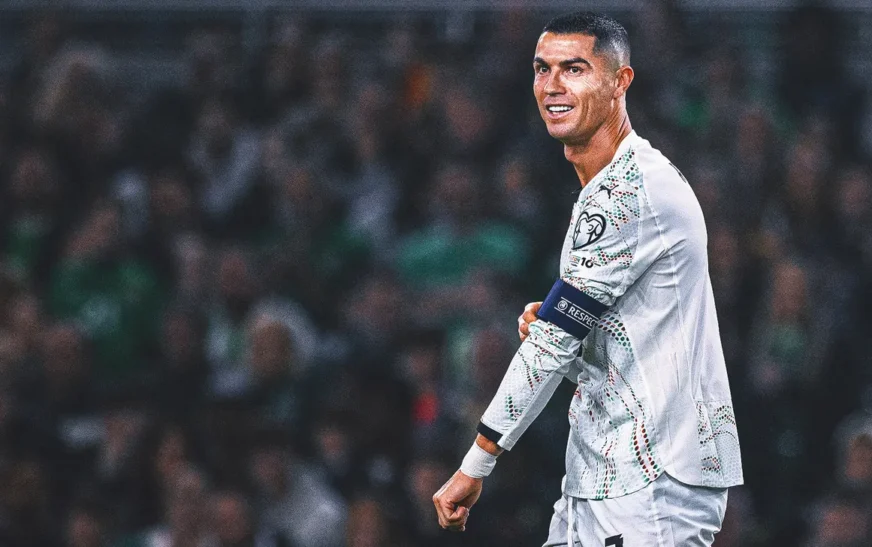
Football analyst and former Scotland midfielder Craig Burley has launched a scathing criticism of FIFA following its decision to alter Cristiano Ronaldo’s disciplinary ruling, accusing the world football governing body of compromising its integrity to protect star power ahead of major tournaments.
Ronaldo, who plays for Saudi Arabian club Al-Nassr, was suspended for Portugal’s final Euro qualifier against Armenia after receiving a red card for violent conduct in a previous match. Under standard disciplinary procedures, such an offence carries an automatic three-match ban. However, FIFA later introduced what has been described as a “probationary allowance,” effectively reducing the suspension and making the 39-year-old forward available for upcoming fixtures.
Speaking on ESPN FC, Burley condemned the decision as a blatant double standard, arguing that FIFA had undermined the credibility of its own disciplinary framework. “If Gianni Infantino had any shame… because let’s be honest, he’d sell his soul for money,” Burley said, referencing the FIFA President. “He’s shown that with the Club World Cup and the extended World Cup. They have made a mockery of their own disciplinary process, a complete shame.”
Burley warned that the ruling sends a dangerous message to referees and football professionals worldwide, suggesting that superstar players receive preferential treatment. “What this says to refs and other professionals is, ‘Maybe you should not send off the big stars keep it to the guys under the radar because we want these big stars at a major tournament.’”
He noted that the disciplinary decision was unprecedented. “When have you ever seen any player get probation after getting sent off for violent conduct?” he asked. “It is a three-game ban and that is it. You cannot give someone a three-game ban and tell them you can have two games off.”
FIFA’s adjusted stance, he argued, creates the perception that the governing body is willing to bend rules when commercial interests are involved, particularly with global icons such as Ronaldo. Burley accused FIFA of “making the rules up for themselves” and eroding fairness in the sport. “If that had been any other player, they would have had the three-game suspension, and they would have missed the World Cup or the first couple of games of the World Cup.”
He added that the organization’s justification for the decision lacked credibility. “For Cristiano Ronaldo, there are different rules, and if FIFA try and tell you anything different, then they are talking absolute nonsense.”
Ronaldo remains one of football’s most marketable figures, and his presence in major tournaments continues to draw global viewership. Critics argue that football authorities often appear reluctant to sideline high-profile players, especially in competitions that generate massive revenues through broadcasting, sponsorship, and global audience engagement.
Portugal, already qualified for the upcoming major tournament, won their final qualifier against Armenia without the forward. However, speculation over his availability had overshadowed the match, prompting intense scrutiny of FIFA’s final decision.
READ ALSO: Natasha Akpoti-Uduaghan’s Trial Adjourned to February 2026
Burley emphasized that the long-term implications of such preferential rulings could be damaging to the sport’s integrity. Analysts warn that if match officials begin to fear repercussions for sanctioning star players, it could lead to inconsistent officiating and erosion of trust in disciplinary mechanisms.
As of now, FIFA has not issued a detailed explanation regarding the adjusted suspension terms, and the controversy continues to stir debate among fans, pundits, and football stakeholders.
For Burley and others critical of the decision, the issue extends beyond Ronaldo himself. It represents a broader concern about how football’s global administrators balance fairness with financial interests in an era where star power significantly influences the economics of the sport.