
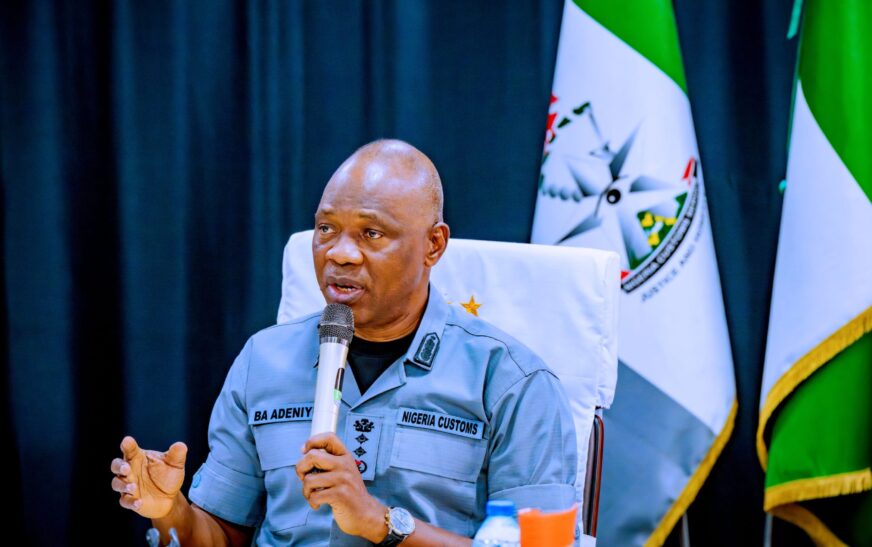
When Bashir Adewale Adeniyi stepped into 2025 as the Comptroller-General of the Nigeria Customs Service (NCS), the expectations were already sky-high. His early reforms in 2023 and 2024 had signaled a break from old patterns, but this year became the true test of his blueprint for a modern, technology-driven, and enforcement-focused Customs Service.
By November 2025, the imprint of his leadership was clear. The story of the year was not just about numbers though the numbers were impressive but about a shift in culture, structure, and ambition within one of Nigeria’s most critical institutions.
Building Momentum: January Kicks Off With Strong Signals
The year opened with Adeniyi rolling out a refined enforcement and digitalization agenda. At Customs Headquarters in Abuja, he reiterated that 2025 would center on reform consolidation, border intelligence, and strengthening Nigeria’s position in global trade. Many expected another routine year of Customs operations. Instead, the service began a steady transformation that would make headlines throughout the first quarter.
In January, he expanded the intelligence units across the six geopolitical zones, setting the tone for stronger anti-smuggling operations. The service also deepened collaborations with the Nigerian Army, Police, and DSS, enabling unified patrols and quick interception of illegal goods. Internally, officers were reminded that the Service was entering a new phase one that demanded transparency, professionalism, and data-driven operations.
A Revenue Revolution Unfolds: February to April
By March, the impact of earlier groundwork became visible. Customs shattered expectations when it reported ₦1.3 trillion in revenue for the first quarter of the year, a staggering rise compared to previous years. Even more intriguing was the detail that this revenue jump occurred at a time when import volumes were actually declining due to foreign exchange volatility.
Adeniyi explained that the spike had little to do with the quantity of imports. Instead, he credited:
- Improved risk profiling
- Higher compliance from importers
- Closure of revenue leakages
- Stricter cargo valuation
- A more transparent digital environment
Technology played a major role. The E-Customs Modernisation Project, a $3.2 billion initiative aimed at digitalizing core operations, moved into critical phases. Automation began reducing human contact at ports, which historically had fueled corruption. Officers were retrained to handle analytics and digital processing tools rather than relying solely on manual checks.
The Authorized Economic Operator (AEO) program also took shape, granting compliant importers faster processing through dedicated green lanes. This not only sped up clearance but also encouraged businesses to operate within the formal system. For the first time in years, top manufacturers openly praised Customs for making clearance less chaotic.
Adeniyi’s message remained consistent: revenue would rise not by burdening traders, but by tightening systems.
Battling Smuggling with New Arsenal: Strengthening the Borders
As spring rolled in, the Service entered an aggressive anti-smuggling phase. Smuggling has long been one of Nigeria’s most persistent economic wounds, draining revenue and distorting competition for local producers. Under Adeniyi’s watch, enforcement became more intelligence-led and less reactionary.
Joint border patrols at Seme, Idiroko, Jibia, and other hot zones became routine. More drones were deployed for surveillance. The Customs Air Wing, still in its early growth stage, supported operations with aerial reconnaissance. Officers intercepted:
- High-end vehicles smuggled across land borders
- Arms and ammunition disguised in cargo
- Illicit drugs hidden inside sealed containers
- Thousands of bags of foreign rice rerouted through porous border points
By mid-year, Customs reported recovering over ₦64 billion from previously undervalued imports and seized hundreds of illegal consignments. The public reaction was mixed some worried about harsher scrutiny at borders, but many acknowledged that illegal trade had reached unsustainable levels.
Trade Facilitation Becomes a Centrepiece: Mid-Year Reforms Take Hold
June and July reshaped the year’s narrative. Adeniyi’s focus shifted from enforcement to broader trade facilitation. He intensified work on the National Single Window, a platform designed to bring all government agencies under one digital ecosystem. Traders had long complained about the exhaustion of going through up to 15 agencies manually. The Single Window promised a seamless, unified, online system.
At the ports, clearance time for compliant traders dropped dramatically from about 21 days to between 7 and 10 days. For a system notorious for long queues and bottlenecks, this was a breakthrough.
Adeniyi also strengthened the Agro-Export Fast Track Scheme, ensuring that agricultural exporters moved their products faster, with fewer bureaucratic delays. Nigeria has been pushing to grow non-oil exports, and Customs’ cooperation is essential to this ambition.
Exporters of cocoa, sesame seeds, ginger, hibiscus, and cashew repeatedly testified at business forums that Customs was becoming more predictable and less confrontational.
A Vote of Confidence: Presidential Support and Tenure Extension
In July, a major moment defined the year: President Bola Tinubu extended Adeniyi’s tenure by one year. The presidency cited his ongoing reforms, leadership stability, and the need for continuity as reasons for the extension.
This move sent a powerful message. It affirmed that the government was satisfied with the direction of Customs and wanted Adeniyi to complete key projects, especially the E-Customs system and the national trade automation drive. Officers across commands read this as motivation, and morale visibly improved.
Institutional Reshaping: Training, Discipline, and New Culture
From August through October, Adeniyi turned internal. He focused on building a stronger workforce one that could handle modern customs operations.
Over 1,800 officers underwent specialized training in:
- Data analysis
- Artificial intelligence applications
- Risk management
- Modern cargo inspection
- International customs standards
He also tightened internal discipline. Commands that performed well were rewarded publicly, while those with widening leakages received administrative attention. Complaints that usually lingered for months began receiving quicker responses.
By October, the Service was gradually shedding its old identity. A younger, digitally-aware workforce emerged, better prepared to manage Nigeria’s complex supply chain environment.
Port Performance Peaks: The Tincan Benchmark
In late October, stakeholders were startled when reports showed that Tincan Island Port Command generated ₦747.08 billion within six months nearly a third more than the previous year. According to civil society observers, this performance was directly tied to the reforms happening nationwide.
It was one of the clearest indicators yet that the reforms were not only theoretical, but operational.
Navigating Challenges: The Tough Realities of Reform
Despite the impressive gains, Adeniyi’s year wasn’t without challenges.
- Technology adoption: Digital reforms require deep buy-in from officers and stakeholders. Not all commands adapt at the same rate, and some officers struggled with the transition from manual processes.
- Border complexity: Nigeria’s borders span deserts, forests, rivers, and isolated rural communities. Even with better tools, securing all points remains difficult.
- Inter-agency alignment: Trade facilitation depends on many agencies. Customs may be fully automated, but if other players lag, the system becomes slower.
- Trader resistance: As the Service tightened revenue collection, some importers complained about higher assessments or stricter valuation. Systems that eliminate shortcuts often trigger initial pushback.
Yet, through the setbacks, Adeniyi held the line, arguing that reforms of this scale cannot be smooth from start to finish.
The Final Stretch: November’s Consolidation Drive
As the year approached its close, November became a month of consolidation. Adeniyi reviewed the progress of the digitalization project, assessed compliance rates across commands, and met with stakeholders across the ports.
He stressed that the Service was preparing for a future where:
- Most clearances would be automated
- Human contact would be minimal
- Border surveillance would depend on drones and sensors
- Export turnover would rise
- The cost of doing business at ports would steadily fall
He also emphasized that Customs was positioning itself to support Nigeria’s export diversification agenda, especially in agribusiness and solid minerals.
A New Customs for a New Economy
By the end of November 2025, the story of the Nigeria Customs Service was one of measured but undeniable transformation. Adeniyi’s leadership produced eight defining outcomes:
- Record revenue performance in a period of reduced import volumes.
- A digital movement that placed automation at the center of port operations.
- Stronger border security, powered by intelligence rather than guesswork.
- Faster processing times for compliant businesses.
- Clearer valuation methods, reducing corruption and informal charges.
- A more skilled workforce, better equipped for modern customs operations.
- Improved public confidence, especially among exporters.
- A forward-leaning institution, ready for deeper reforms in 2026.
Adeniyi’s Legacy in Motion
In a country that depends heavily on customs revenue and cross-border trade, the transformation inside the NCS has wide implications for the economy. The Service is now poised to support Nigeria’s push toward diversification, competitiveness, and better trade efficiency.
READ ALSO: Ihesiulo Grace Amarachi – CEO of AdaEventsNews Nigeria
Adeniyi’s work from January to November 2025 laid the foundation for a Customs Service that is more transparent, more efficient, and more technologically aligned with global standards. Whether it’s in revenue growth, enforcement strength, or digitization, the year’s achievements stand as some of the most significant milestones in the history of the Nigeria Customs Service.
For a system once defined mainly by bottlenecks and leakage, 2025 became a year of reinvention — and at the center of this shift is a Comptroller-General determined to rewrite how Customs works for the country.