
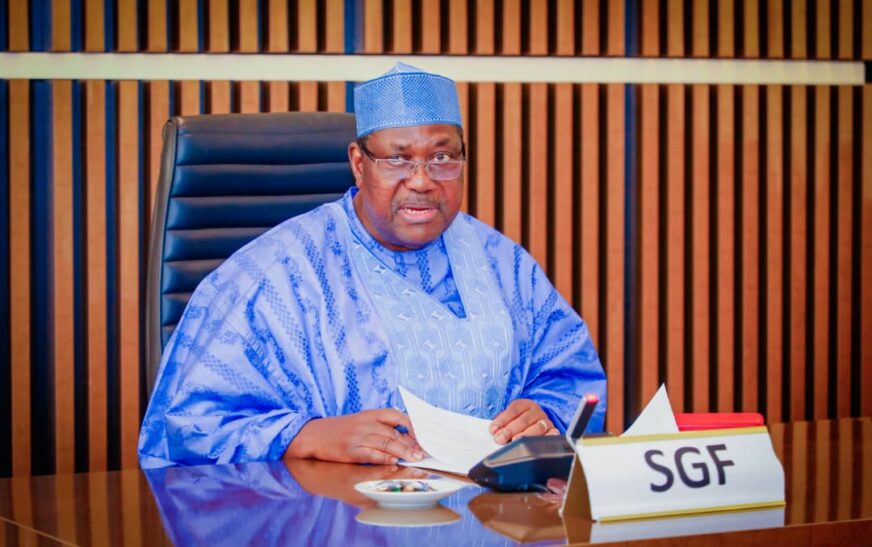
In the first eleven months of 2025, Senator George Akume, a former governor, federal lawmaker, and now Secretary to the Government of the Federation (SGF) emerged as one of the central forces shaping the administrative machinery of the Tinubu presidency.
From managing inter-ministerial coordination to navigating intense political pressures, Akume’s actions across the year reflect the delicate balance required to hold together a complex federal system under economic strain, shifting political allegiances, and rising public scrutiny.
Operating largely from behind the scenes but frequently stepping into public view, Akume’s tenure in 2025 demonstrates the evolving role of the SGF: part administrator, part crisis-manager, part political broker, and part spokesperson for governmental stability.
This extensive news report chronicles his activities between January and November 2025 a period marked by national policy recalibration, governance turbulence, reforms, committees, and recurring battles over misinformation.
A YEAR THAT BEGAN WITH PRESSURE
January 2025 opened with Nigeria facing inflation, insecurity in rural communities, and surging public frustration with governmental performance. The Office of the Secretary to the Government of the Federation (OSGF), which oversees inter-ministerial coordination and implementation of presidential directives, became the hub of crucial decisions meant to reset federal efficiency.
Akume’s first major task of the year was chairing the Presidential Delivery Coordination Framework sessions. These meetings, which convened ministers, special advisers, permanent secretaries, and technical delivery units, were aimed at enforcing measurable performance indicators. The SGF insisted that each ministry submit quarterly performance targets a demand that, according to insiders, “put some ministers on alert” after responses lagged during the final quarter of 2024.
For Akume, whose political reputation leans heavily on experience and discipline, the January meetings set the tone: the Presidency expected implementation, not political rhetoric.
RECALIBRATING FEDERAL-STATE RELATIONS
From February through May, Akume intensified engagements with state governments through the SGF–SSGs Forum, a platform that had grown dormant in earlier administrations. The forum’s resurrection under his leadership created a channel to address cross-cutting issues: revenue allocation disputes, implementation of federal programmes at the state level, and security coordination between governors and federal agencies.
At the second quarter meeting in Jos, Akume’s message was direct:
“If we want to see national development, federal and state governments must stop working in silos. Coordination is not an option it is the foundation.”
These meetings were widely interpreted as an attempt to prevent policy sabotage, align administrative timelines, and calm partisan tensions in politically mixed states. Analysts observed that the forum helped reduce bureaucratic friction in national programmes such as the school feeding rollout, agricultural input distribution, and emergency response protocols.
For a country where federal–state parallelism often leads to duplication or failure, Akume’s approach marked a significant administrative reset.
A PUBLIC VOICE ON UNITY IN A TENSE YEAR
Religious and ethnic tensions in parts of the country escalated mid-year, prompting the SGF to step forward as a public advocate for social cohesion.
In early May, during a national interfaith roundtable held in Abuja, Akume appealed to religious leaders to help de-escalate community-level tensions.
“The responsibility of building a united Nigeria does not rest solely on the government. Religious leaders carry a powerful moral influence. This year demands that we use that influence wisely.”
He reiterated the call during a meeting with traditional rulers in the North Central region, urging them to resist the spread of inflammatory rhetoric, especially across social media channels saturated with deepfake videos and false political narratives.
Security analysts later noted that the SGF’s interventions helped lower political temperatures ahead of several state governorship primaries that had threatened to spill into violence.
COMMITTEES, COORDINATION, AND CRISIS MANAGEMENT
One of the defining characteristics of the Akume-led office in 2025 was the strategic use of inter-ministerial committees to address emerging national challenges.
1. National Events and Commemorations
The SGF’s office led the planning of Democracy Day in June, Independence Day in October, and Armed Forces Remembrance activities. These events, while symbolic, also served to showcase federal capacity in national mobilisation.
2. Public Service Reforms
Akume presided over reforms aimed at digitising federal administrative processes. The Office of the Head of Civil Service, working under SGF oversight, accelerated the transition to digital documentation in several ministries.
3. Environmental Coordination
One of the most policy-shaping committees emerged in November: an inter-ministerial committee on phasing out single-use plastics. Environmental groups praised the step as “long overdue,” while manufacturers warned that it could disrupt local industries.
4. Security and Police Council Engagements
Akume’s office coordinated strategic meetings with the Police Council to review federal–state security cooperation. Although the SGF does not direct security agencies, he plays a facilitating role that shapes high-level consensus.
His management style was repeatedly described by associates as “calm but firm,” driven by deadlines, and characterised by a willingness to disrupt traditional bureaucratic inertia.
THE MID-YEAR RUMOURS THAT TESTED THE SGF’S OFFICE
Perhaps the most politically charged episode of the year was the swirl of rumours in June that the SGF was set to be replaced. The claims spread widely across social media and were amplified by anonymous political blogs.
By the third week of June, the false narrative had gained enough traction that the Presidency issued an official statement reaffirming that Akume remained in office and dismissing the rumours as “baseless political fabrication.”
Days later, Akume himself responded not to fuel the uproar but to shut it down.
“I remain fully focused on my responsibility to the President and the Nigerian people. Distractions do not shape our national priorities.”
The episode illustrated the fragility of political positions within the ruling party and the speed at which misinformation could destabilise public perception. It also showed Akume’s instincts for administrative survival: he stayed silent until necessary, then delivered a concise rebuttal.
POLITICAL PRESSURES: THE PARTY CHAIRMANSHIP QUESTION
Barely a month after the replacement rumours faded, another political storm surfaced: speculation that Akume would step down to become national chairman of the All Progressives Congress (APC). The position had become a power-brokering seat, and several factions wanted a loyalist with federal visibility to occupy it.
But Akume refused.
In a brief but firm statement, he clarified:
“My responsibility at this time is to the government and the Nigerian people through the office I currently hold. That is my focus.”
His refusal reshaped internal party calculations. Analysts later observed that the SGF had strategically avoided a role that would entangle him in factional battles and compromise his administrative neutrality. Remaining outside the party’s day-to-day politics enabled him to maintain institutional access and influence across factions.
EDUCATION, ECONOMY, AND THE PUBLIC MESSAGE OF ACCOUNTABILITY
Throughout 2025, Akume repeatedly emphasised the government’s focus on education, youth empowerment, and public accountability.
1. Education Advocacy
He addressed several national stakeholders’ meetings, calling education “the most reliable path to long-term security and economic renewal.” Under his coordination, federal agencies intensified work on student loan rollout, teacher training reforms, and digital learning initiatives.
2. Economic Messaging
During a policy briefing in August, Akume highlighted the federal government’s efforts to ease the cost of living through coordinated actions involving the Ministry of Finance, Agriculture, Trade, and the Central Bank.
3. Anti-Corruption Warnings
A recurring theme in his speeches was a warning against “fake appointments” and forged employment letters, a scam that surged as desperation for federal jobs increased. Akume urged Nigerians to verify every job offer either through the OSGF or respective ministries.
MANAGING NATIONAL SYMBOLISM: DEMOCRACY DAY AND INDEPENDENCE
June’s Democracy Day celebration gave Akume a rare moment in the national spotlight. His office coordinated the parade, national broadcast logistics, security clearances, and presidential message drafting. Analysts described the event as “tightly managed and politically symbolic,” with the SGF positioned as the central administrator ensuring order and consistency.
A similar effort unfolded in October during Nigeria’s 65th Independence anniversary. The SGF chaired the planning committee, harmonising activities across ministries and agencies to project national unity at a time of rising economic anxiety.
NOVEMBER: ENVIRONMENT, BUREAUCRATIC OVERHAUL, AND NATIONAL COORDINATION
By November, Akume’s activities reached a peak. The highlight was the inauguration of the Inter-Ministerial Committee on Phasing Out Single-Use Plastics, a key step in Nigeria’s environmental policy alignment with global sustainability standards.
Environmental activists praised the move as “a landmark shift,” while manufacturers, hoteliers, market associations, and importers expressed concerns over timelines, costs, and alternatives. Akume acknowledged the concerns but insisted that Nigeria could not “afford to stand outside global environmental progress.”
READ ALSO: Ihesiulo Grace Amarachi – CEO of AdaEventsNews Nigeria
November also saw his office coordinate a federal–state administrative retreat in Abuja, focusing on performance dashboards for ministries, reforms to the public procurement process, and service delivery improvements. Participants described the retreat as the OSGF’s most engaging policy session of the year.
AKUME’S MODEL OF GOVERNANCE: STEADY, QUIET, AND DELIBERATE
Throughout the year, Akume showcased a style of governance rooted in long-term political experience. Unlike more flamboyant political figures, he spent much of 2025 operating within structured bureaucratic lanes:
- convening committees
- facilitating inter-ministerial agreements
- shaping policy timelines
- managing political tensions discreetly
- addressing strategic national issues without frequent press conferences
His critics, however, argue that the absence of dramatic reforms reflects “too much coordination and not enough enforcement.” Supporters counter that an SGF’s job is not to dictate policy but to ensure cohesion among ministries that often compete for influence.
CONTEXTUAL ANALYSIS: WHAT THE YEAR SAYS ABOUT GOVERNANCE
1. Nigeria’s governance system relies heavily on the SGF
The SGF ensures that presidential directives move from intention to implementation. In a complex federal structure with 36 states and numerous agencies, the office is the engine room of federal coordination.
2. The rise of misinformation shapes political survival
The mid-year rumours about Akume’s removal reveal how quickly misinformation can be weaponised in Nigerian politics. His handling of the situation demonstrated the need for coordinated government communication.
3. Environmental governance became a major policy frontier
The plastics committee signaled a growing federal commitment to environmental responsibility, a space where Nigeria had lagged behind global progress.
4. Federal–state relations improved under Akume
The SGF–SSGs Forum revived coordination mechanisms that had previously remained dormant, creating opportunities for smoother intergovernmental delivery.
LOOKING AHEAD: WHAT AKUME’S 2025 MEANS FOR 2026
As 2025 winds down, the SGF’s impact will be measured not by committees inaugurated or speeches delivered, but by the implementation outcomes in 2026:
- Will ministries meet the performance indicators he set?
- Will the plastics policy become enforceable regulations?
- Will public service digital reforms reduce inefficiency?
- Will federal–state coordination translate into real improvements?
Political watchers say Akume’s next test is whether he can turn administrative coordination into measurable socio-economic advancement.
CONCLUSION: A YEAR OF STABILITY IN THE MIDST OF UNCERTAINTY
From January to November 2025, Senator George Akume played a stabilising role in a year marked by political speculation, misinformation, rising public anxiety, and complex policy challenges. His leadership emphasised structure, coordination, and calm administrative control traits that helped maintain institutional continuity in a fractious political environment.
Whether viewed as a quiet operator or a strategic stabiliser, Akume’s 2025 activities reinforced the centrality of the SGF’s office in Nigeria’s governance architecture. As the nation steps into 2026, the effectiveness of federal policy delivery may depend heavily on whether the systems he strengthened can deliver results where they matter most: in the daily lives of Nigerians.