

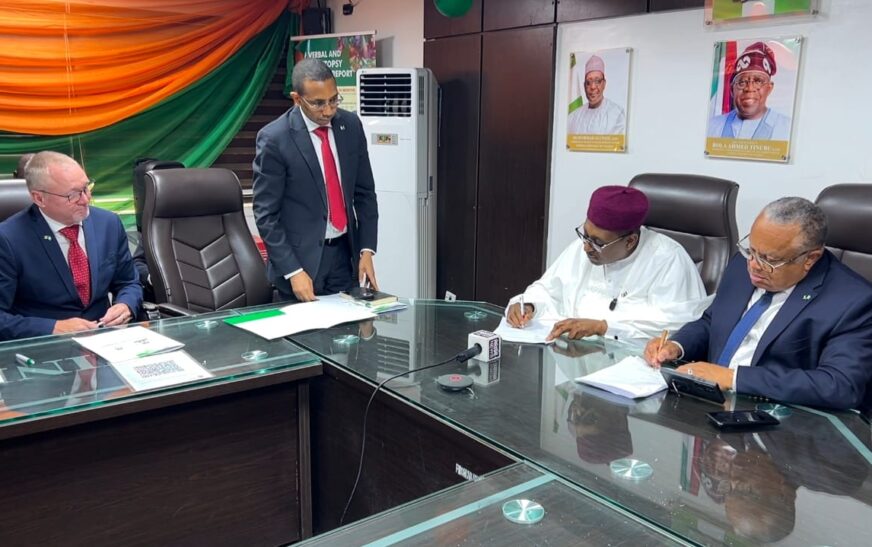
Nigeria and Barbados have taken a decisive step toward reshaping pharmaceutical production across Africa and the Caribbean with the signing of a new Memorandum of Understanding (MoU) aimed at boosting local manufacturing and tightening regional health security.
The agreement, sealed on Tuesday in Abuja, brings together Nigeria’s Presidential Initiative for Unlocking the Healthcare Value Chain (PVAC) and Barbados Pharmaceutical Inc. (BPI), with the ceremony witnessed by the Coordinating Minister of Health and Social Welfare, Prof. Muhammad Ali Pate.
The pact is being described within government circles as a breakthrough for South–South cooperation, opening fresh pathways for industrial growth, regulatory collaboration and market expansion.
With ministerial endorsement from both sides, the MoU signals a long-term commitment to scaling up pharmaceutical capacity in Nigeria while creating new commercial and regulatory linkages between West Africa, the Caribbean Community (CARICOM), Latin America, and broader trade blocs such as ECOWAS and the African Continental Free Trade Area (AfCFTA).
READ ALSO: Ihesiulo Grace Amarachi – CEO of AdaEventsNews Nigeria
Under the framework, Nigeria and Barbados will pursue joint initiatives that support domestic production, modernize policy and regulatory systems, and mobilize financing in line with PVAC’s model of deal-driven health sector transformation.
Officials say the partnership is structured to help Nigeria transition from a heavily import-dependent drug market to a more resilient, innovation-backed pharmaceutical hub capable of meeting domestic demand and supplying regional markets.
Prof. Pate said the collaboration aligns squarely with President Bola Ahmed Tinubu’s wider ambition to industrialize the health sector, strengthen supply chains and secure long-term access to essential medicines.
He highlighted Nigeria’s expanding pharmaceutical landscape, improving regulatory systems and deepening primary healthcare uptake as factors that make the country an attractive partner for global investors.
“We are committed to building a health sector that is competitive, sustainable and better positioned to serve our people,” Pate noted.
“This partnership with Barbados supports our goal of reducing reliance on imported medicines and expanding Nigeria’s footprint in regional markets. It reinforces our drive to secure not only national health security but regional security as well.”
Barbados, which has been pursuing its own industrial reforms and healthcare modernization, sees the partnership as a chance to integrate more deeply with African markets.
Its delegation, led by Senior Minister of Health and Wellness, Dr. Jerome Walcott, emphasized that the collaboration provides a foundation for shared industrial development and pharmaceutical innovation across both regions.
For Barbados Pharmaceutical Inc. (BPI), the agreement opens the door to technical exchanges, manufacturing partnerships and long-term access to Nigeria’s large and growing market. More broadly, it also anchors Barbados’ plan to establish itself as a key Caribbean node for biomanufacturing and medical product exports.
One of the most significant components of the MoU is its push toward regulatory alignment. Nigeria’s National Agency for Food and Drug Administration and Control (NAFDAC) and Barbados’ emerging Medical Products Regulatory Authority will begin discussions on a regulatory reliance arrangement.
Such cooperation, experts say, can shorten approval timelines, improve oversight and encourage cross-border investment in pharmaceutical manufacturing.
Dr. Abdu Mukhtar, National Coordinator of PVAC, described the MoU as a natural extension of Nigeria’s ongoing reforms to strengthen the healthcare value chain.
He explained that PVAC has already attracted private investment into diagnostics, vaccines, medical oxygen and other critical areas, and the partnership with Barbados adds another dimension to that momentum.
“Our goal is simple: build a strong, competitive health industry that serves Nigeria and contributes to global health supply chains,” Mukhtar said. “Working with Barbados helps accelerate this vision. It connects us to new markets, new expertise and new investment opportunities.”
As part of the visit, the Barbadian delegation will tour biomedical and pharmaceutical facilities, including AMA Medical Manufacturer, to explore opportunities for collaboration and technology transfer. Discussions are also underway on setting up a Barbados-based production hub that could eventually link supply chains across the Caribbean and Africa.
Stakeholders say the partnership is arriving at a critical moment, as both regions grapple with the lessons of the COVID-19 pandemic and the need to build resilient, self-sufficient health systems.
By teaming up, Nigeria and Barbados hope to anchor a new model of interregional cooperation one that strengthens access to medicines, supports industrial growth and improves health outcomes across continents.
With the signing now complete, technical teams from both countries are expected to begin implementing workstreams immediately, setting the stage for fresh investments, regulatory alignment and expanded trade in medical and diagnostic products.